
What Access Is Needed to Install a Garden Marquee?
Access for a garden marquee means the whole journey from the delivery vehicle to the installation area, including the return journey for collection. A wide gate is useful information, but it does not explain a tight corner, a flight of steps or a long route behind the house.
For homeowners and event organisers in Essex, the practical starting point is to describe that journey accurately. This guide explains what to measure, photograph and send before an installation is planned. The supplier must assess the route against the actual equipment and working arrangements; your measurements alone cannot confirm suitability.
Quick Answer
- Ask the supplier to review the complete unloading-to-garden route before relying on it for delivery and installation.
- Record clear gate openings, narrow passages, turns, steps, changes of level and visible overhead obstructions.
- Show the proposed unloading location and carrying distance, with any parking, timing or shared-access restrictions.
- Send a labelled sequence of photographs alongside measurements, then confirm what arrangements are needed for collection.
- Pause if the route is unsafe, permission is unresolved, or access depends on an unapproved alteration. Do not improvise a workaround on delivery day.
What This Guide Cannot Decide
This checklist does not provide a minimum gate width, overhead clearance, maximum carrying distance or list of accepted site restrictions. Those details need confirmation for the equipment being supplied. A measurement above a number found elsewhere is not approval for your garden.
Access also differs from installation suitability. Reaching a lawn does not establish whether the marquee can be installed there. Ground conditions, underground services, the structure and its installation method require their own assessment. This guide does not replace that work or instruct you to move heavy equipment.
When to Stop and Refer the Route for Advice
Do not enter an unstable or hazardous area to complete the checklist. Stop if checking a dimension would require climbing, reaching near overhead wires or crossing an unsafe surface. Describe the uncertainty and ask the supplier what information can be gathered safely.
Refer proposed fence removal, temporary ramps, access through a building or use of someone else’s land for discussion before making arrangements. Neither an improvised structure nor an offer of extra helpers establishes a safe carrying method.
If overhead lines are present, leave their identification and clearance assessment to the appropriate professionals and line owner. HSE’s guidance on overhead power lines explains that dangerous electrical contact can occur without touching the line. Do not raise a tape, pole or other object towards a wire to measure it.
Think About Access as a Complete Journey
Separate the delivery journey into three parts: where the vehicle can arrive and unload, how equipment reaches the garden, and where the installation team will work. Write down any uncertainty at the point where it occurs. Saying “rear access available” leaves all three parts open to interpretation.
A supplier may need to assess more than whether individual items can pass through an opening. The route also has to support the way the work will be carried out. HSE’s manual handling assessment guidance considers the task, load, working environment and individual capability, including carrying distance and cramped working areas.
Use the same approach when discussing garden marquee hire and installation. Explain the access route alongside the intended event and garden position, so the supplier can identify what needs further checking.
MBC Hires states in its marquee delivery and access FAQs that standard pricing assumes vehicle access reasonably close to the installation area and a clear carrying route. Restricted access, stairs or longer carries may affect timing and pricing. That published explanation does not confirm acceptance of a particular route.
Decide What Kind of Access Enquiry You Need
You can describe the entire route
If the route is safely accessible and you can record its main features, prepare the measurements and photographs below. Send them for review with the event details. This is enough to start a useful discussion, but it is not a reason to promise other suppliers that installation is confirmed.
One part of the route is uncertain
Identify the missing information precisely. Perhaps the rear gate is locked, a passage belongs to a neighbour, or unloading would depend on space outside the property. Ask the person responsible for that area about access, and tell the hire supplier what remains unresolved.
A wider alternative may involve a longer carry or a different surface. Present both possibilities with their limitations rather than selecting one solely because its gate looks larger.
The proposal depends on a difficult or unsafe workaround
Pause the access decision if equipment would need to cross damaged ground, pass an unresolved overhead hazard or use an alteration that has not been assessed. Ask whether a different route, garden position or event arrangement could be considered.
Do not treat a small marquee as an automatic answer to difficult access. The supplier still needs to assess the equipment and handling involved. If no suitable route can be agreed, reconsider the location before committing further to the event.
Check the Route in the Order Equipment Would Travel
1. Identify the arrival and unloading point
Give the full address and explain which entrance leads to the garden. If a postcode brings drivers to another side of the property, describe the correct approach. Note any controlled entrance, private track or venue check-in arrangement that affects arrival.
Photograph the proposed unloading location from a safe position. Explain whether it is on your drive, in a shared area or on the street, and identify any signs, time restrictions or permissions that need checking. An empty space in a photograph should not be presented as a reserved unloading place.
Tell the supplier if other vehicles, deliveries or pedestrians normally use the same area. Ask how unloading can be coordinated with those activities. HSE’s loading and unloading safety guidance calls for separation from people and traffic not involved in the operation, and for arrangements between the parties to be agreed in advance.
Do not assume that a delivery vehicle can enter a drive because a car fits there. Provide the route information and let the supplier assess vehicle access. Identify any known ground or property concern instead of testing the route by driving a vehicle over it.
2. Measure the opening that will actually be available
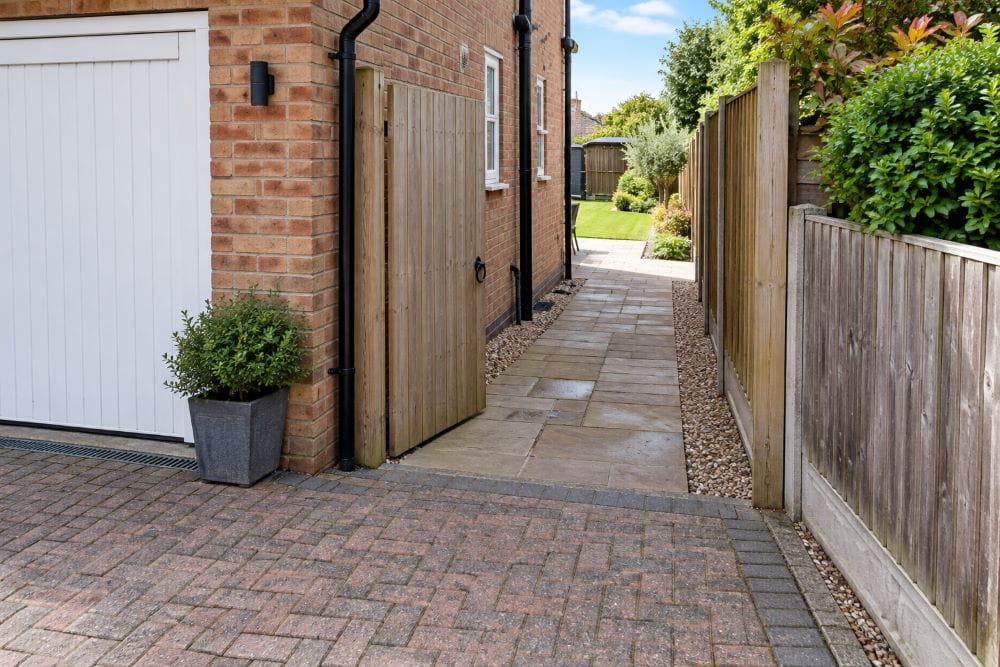
Where it is safe to do so from ground level, open the gate as it would be opened for delivery and record the clear space between the obstructions. Measure the available opening, rather than quoting the nominal size of the gate panel.
Include anything that reduces that opening, such as a projecting latch, post, fixed planter or gate that cannot open fully. Photograph the gate open as well as the approach to it. If two leaves can open, state whether both will actually be available.
Label dimensions with units and identify exactly where you took them. A note such as “clear opening between the open gate and fixed post” is more useful than “gate width”. Record an estimate as an estimate; ask for help if an accurate measurement cannot be taken safely.
Keep existing structures in place during this information-gathering stage. A removable-looking panel or gate is not an agreed access solution until permission, the work involved and the supplier’s requirements have been discussed.
3. Follow passages, corners and overhead restrictions
Continue beyond the gate. Mark narrow stretches beside the house, changes in direction and places where the route passes a shed, downpipe or other fixed feature. Photograph both the approach to a corner and the route after it.
Explain where there is room before and after a turn. A single width does not show the whole movement through a corner. The supplier should decide what additional dimensions or inspection are needed for the items being delivered.
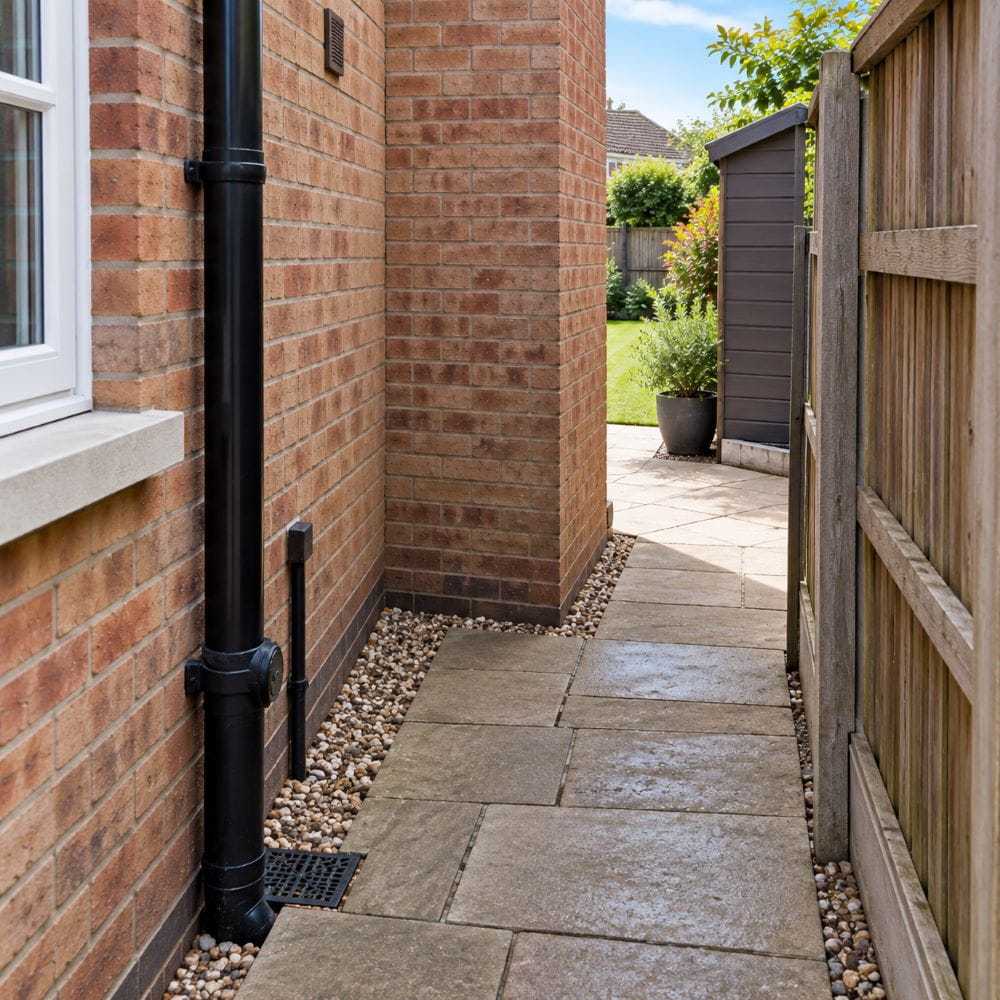
Record low doorways, arches, covered passages and overhanging branches. Measure an accessible non-electrical opening only if you can do so safely from the ground. Leave uncertain heights unmeasured and photograph the feature from a safe location. The earlier warning about overhead lines applies throughout this check.
If the proposed journey goes through a garage, hallway or another building, make that explicit. Include internal doors and turns, who controls access and any concern about existing finishes. Ask whether the route can be considered before planning to move furniture or remove doors.
4. Describe steps, surfaces and changes of level
Record where steps occur, whether they rise or descend towards the garden, and whether a turn or landing interrupts them. A photograph from each safe end can explain the arrangement better than a close-up of one step.
Note the surfaces along the route, such as paving, gravel, grass or decking, without declaring them suitable for handling equipment. Mention visible damage, soft areas, slopes or changes between materials. Share known concerns about covers, drainage or recent ground works for the supplier to assess.
Photographs show conditions at one moment. Rain can make some surfaces slippery, and poor lighting can conceal hazards. Tell the supplier if the route commonly becomes wet or if delivery or collection may happen when natural light is limited.
Do not cover a problem with loose boards, mats or a makeshift ramp and assume it has been resolved. Describe the problem first. Any proposed access aid or protective arrangement needs to be considered by the appropriate supplier before use.
5. Record the carrying distance to the intended position
Follow the actual proposed route from the unloading point to the marquee location, rather than measuring a straight line across the property. If safe and practical, record its length. Otherwise give a clearly labelled estimate and explain how you arrived at it.
Break a complicated journey into sections: drive to side gate, side passage to patio, and patio to lawn, for example. This lets the supplier see where distance and obstacles occur together. Include a simple sketch with the sections named in the same way as the photographs.
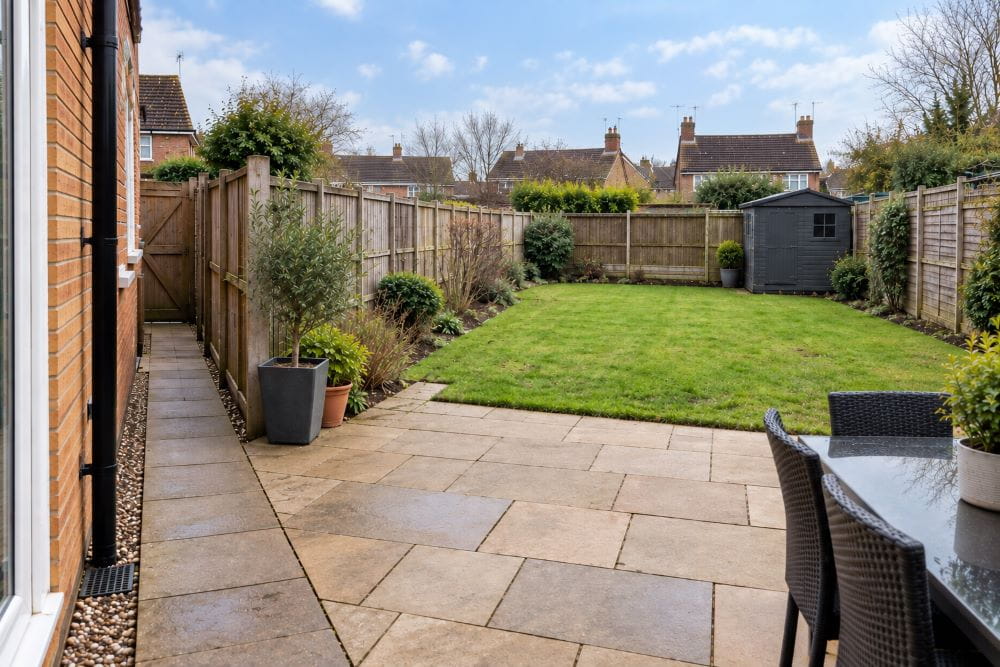
Show the intended garden position and where the route enters that area. Mention any other deliveries or event equipment expected nearby. If the marquee position is flexible, identify the alternative position so the supplier can consider it without guessing which part of the garden you mean.
Send a Clear Access Record
Combine the route information into one message or document. Keep photographs in travel order and give each a short label. Include a wide view for context before a closer view of an obstruction, so the supplier can connect the measurement to the correct place.
A useful photograph sequence might show the unloading area, approach to the gate, open gate, each change of direction, steps or surface changes, and the final garden position. This is a suggested sequence, not a fixed photograph requirement. The supplier may request different views.
- Event: date, postcode, estimated attendance and items being considered.
- Arrival: correct entrance, proposed unloading point and unresolved restrictions.
- Openings: clear measurements with units, locations and estimates identified.
- Route: corners, steps, surfaces, overhead features and approximate total distance.
- Control: who holds keys or controls any shared entrance.
- Timing: when the route is available for delivery and collection.
- Outstanding questions: anything you could not inspect, measure or confirm.
Keep the information factual. “There are steps after the side gate; photographs attached” gives the supplier something specific to assess. “Access should be fine” does not explain the route. Avoid using a previous delivery by another company as proof that the planned installation can proceed.
A short video can supplement still photographs if requested. Record it without walking backwards or concentrating on the screen while negotiating steps. Avoid including people or unrelated private areas when they do not help explain the route.
Compare Alternative Routes Without Guessing Which Will Work
Consider this illustrative situation: a side passage leads directly to the garden but includes a turn behind the house. A rear gate appears wider, but it opens onto a shared lane controlled by someone else. Neither option should be selected from the gate width alone.
For the side passage, the useful questions concern the opening, the turn and the space around it. For the rear route, the questions also include permission, unloading arrangements, the onward carrying route and access at collection time.
Send the two descriptions together. Ask the supplier which route needs further information and what would have to be confirmed before it could be used. Keep a proposed alternative clearly marked as unconfirmed until the people involved have agreed to it.
The comparison is helpful because it separates a visible feature from an operational assumption. It does not establish that either route is suitable, and it is not an example of a completed client installation.
Common Access-Planning Mistakes
- Sending only a gate measurement: it leaves the approach, turns and onward route unexplained.
- Photographing the garden but not the journey: the installation space is only the final part of the access enquiry.
- Measuring the shortest line on a map: the carrying route may follow a longer path around buildings and boundaries.
- Assuming street parking will be available: the proposed stopping point and any restrictions still need checking.
- Offering helpers as the solution: extra people do not replace the supplier’s handling assessment or agreed working method.
- Leaving access information until the booking is final: the supplier may then need to review arrangements, timing or price.
- Planning delivery but forgetting collection: a locked gate or parked vehicle can change the return route.
Keep Delivery and Collection Access Available
Once a route is agreed, record who will open it and when. Arrange a contact who can answer access questions on the day. If that person changes, pass on the route details and the supplier’s agreed conditions.
Before arrival, deal with ordinary movable obstructions that you can safely remove, such as bins or lightweight garden furniture, where that forms part of the agreed plan. Leave structural alterations and equipment handling to the appropriate people. Keep children and pets away from the work area.
Tell the supplier about changes such as road works, a skip on the drive, a damaged path or a newly locked shared gate. Do not substitute a different route without discussion. Collection may take place under different parking, weather or access conditions, so review the return arrangements too.
The booking conditions for site access and collection explain the importance of accurate site information and access at the agreed time. Read them alongside your quotation and ask about any condition you do not understand.
Keep the agreed route free of event furniture and stored belongings during the hire period where it is needed for collection if something prevents that, notify the supplier before the collection visit rather than expecting the team to discover it on arrival.
How to Get This Done
Gather the route description, photographs and safely obtained measurements before asking for an access decision. Identify your preferred marquee position, any alternative route and the questions that remain unanswered. Include the date, postcode, estimated guest numbers and hire items.
Use the contact page to send your garden access details for a hire enquiry. MBC Hires specifically requests access information such as gate widths, steps and long carrying distances alongside the event details.
Ask what can be assessed from the information supplied and whether further photographs, measurements or a site check are needed. The response should make clear which route is being considered, what still needs confirmation and whether access affects the quotation or proposed arrangements.
Before relying on the plan, confirm the unloading point, access availability, any preparation allocated to you and the collection arrangements. Keep that reply with the booking details. A useful access enquiry ends with clear responsibilities, not an assumption that someone will find a way through.
Summary
Show the complete journey from unloading to the garden and back again. Record actual openings, route changes, surfaces, distance and who controls access. Clear information helps the supplier assess the proposal; suitability and any necessary conditions still need their confirmation.
Frequently Asked Questions
-
How wide must a gate be for marquee installation?
Ask the supplier about the equipment proposed for your event. Provide the clear opening with the gate open, plus photographs of the approach and route beyond it. This guide gives no universal minimum width, and a gate measurement alone cannot confirm access.
-
Can marquee equipment be carried through a house?
Do not assume that an indoor route will be accepted. Explain every doorway, corner, step and surface concern, then ask the supplier whether that route can be considered. Do not remove doors or make other alterations before the relevant arrangements are agreed.
-
Do steps or a long garden automatically rule out a marquee?
They need assessment rather than an automatic answer. Describe the steps, surfaces and actual carrying distance, with photographs where safe. The supplier can then explain what information is needed and whether the proposed route affects feasibility, timing or price.
-
Does the delivery vehicle need to enter the garden?
Confirm the proposed unloading and carrying arrangement with the supplier. Do not assume that the vehicle must enter the garden, or that unloading outside the property will be suitable. Show the available approach and the route from the proposed stopping point.
-
Are photographs enough to confirm access?
Photographs are useful supporting information, particularly when linked to measurements and a route description. They may leave uncertainties about dimensions, surfaces or working space. Ask whether the supplier needs further evidence or a site check before making an access decision.
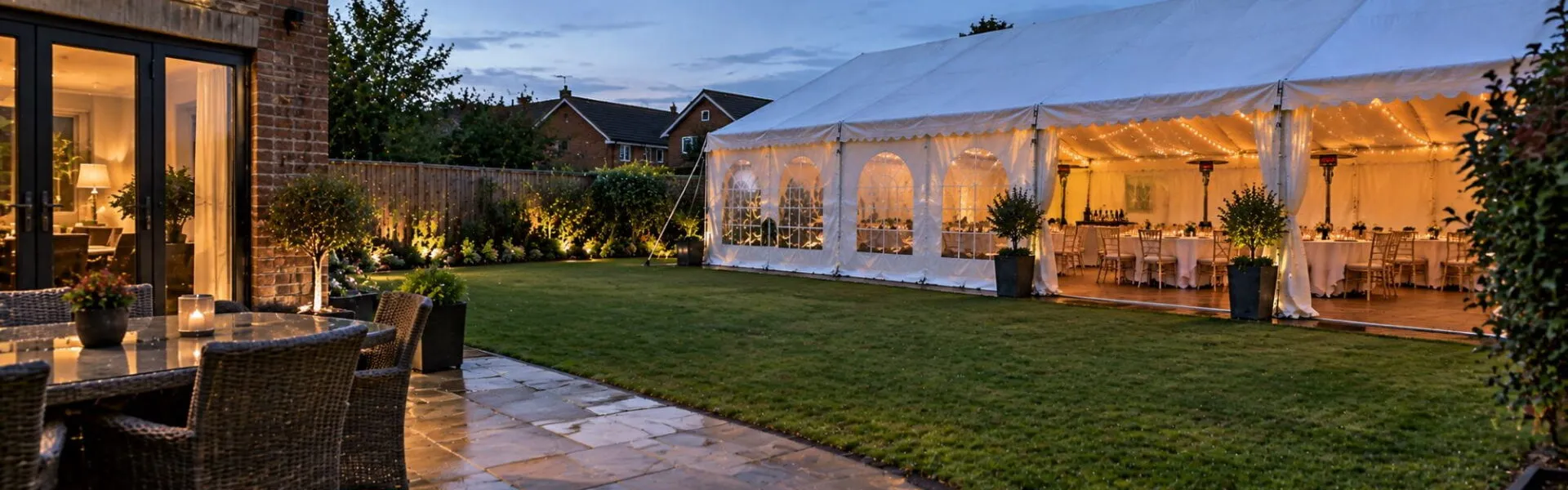
NOT SURE IF YOUR GARDEN ACCESS WILL WORK?
Gate widths are only part of the picture. Steps, narrow passages, tight turns and longer carrying distances can all affect a marquee installation, so send MBC Hires details of the complete route when discussing your event.